What window tint actually is
Window tint is a film bonded to the inside of your glass, and what it is made of decides what it actually does. Dyed film darkens and does little about heat. Carbon blocks meaningfully more infrared and holds its colour. Ceramic is the top of the market: the highest heat rejection at any darkness, no signal interference, colour-stable for life.
Darkness and heat rejection are not the same property. A ceramic film at a barely-visible, legal 70% VLT rejects more heat than a cheap dyed 20% film that looks blacked out. If your problem is a car that bakes in July, buy the chemistry, not the shade. Every quality film also blocks essentially all UV — what cracks dashboards and fades leather.
Who it’s for — and who it isn’t
Worth it if…
- Cars that sit in the sun all day at a commuter lot or job site
- Protecting an interior from UV fade and dash cracking
- Glare on long highway drives
- Privacy for rear passengers, cargo and child seats
We’ll steer you elsewhere if…
- Anyone wanting illegal front-window darkness. New York requires 70% VLT and meters it
- Cracked or chipped glass. Film will not hold it together
- Heat relief on a budget that only reaches dyed film. A light ceramic is the answer
Saying this costs us some jobs. That trade is deliberate.
How the job runs
-
Step 01 15 min
Legal and coverage walkthrough
What New York permits per window, and VLT chosen per position.
-
Step 02 1–3 hrs
Old tint removal, if needed
Steam and solvent, without damaging the defroster grid.
-
Step 03 45 min
Deep glass cleaning
Every speck of contamination under film is visible forever.
-
Step 04 1 hr
Cut and shrink
Heat-shrunk to the curve of the glass. Rear windows are where skill shows.
-
Step 05 1.5–3 hrs
Installation
Applied inside, squeegeed out, edges clean with no light gap.
-
Step 06 3–7 days
Cure
Windows stay up. Slight haze is the adhesive drying.
Window Tint pricing
| Package | Coupe / Sedan | SUV / Truck | Minivan / 3rd-Row SUV | Time |
|---|---|---|---|---|
| Front Two Windows Also the fix for matching factory-tinted rear glass. | Request a quote | Request a quote | Request a quote | 1 hour |
| Rear Windows and Back Glass | Request a quote | Request a quote | Request a quote | 1.5–2.5 hours |
| Full Vehicle | Request a quote | Request a quote | Request a quote | 2.5–4 hours |
| Existing Tint Removal Priced separately because old, baked-on film can take hours. Quoted after we see it. | Request a quote | Request a quote | Request a quote | 1–3 hours |
Front Two Windows includes
- Both front side windows
- Installed at 70% VLT or lighter to meet New York law
Rear Windows and Back Glass includes
- Rear side windows
- Rear windshield
- VLT of your choice — New York does not restrict rear glass on most passenger vehicles
Full Vehicle includes
- All side windows and rear glass
- Legal 70% front split with your chosen shade on the rear
- Windshield strip where permitted
Existing Tint Removal includes
- Steam and solvent removal
- Adhesive residue cleanup
- Defroster grid preserved
Pricing for this service is quoted per vehicle. Send photos with your quote request and you will get a real number back.
VLT chart
VLT is visible light transmission — the percentage of light the glass lets through. Lower is darker. Heat rejection is a property of the film chemistry, not the shade: a good ceramic film at 70% rejects more infrared than cheap dyed film at 20%.
- 70% VLTLegal on NY front side windows
- 50% VLTRear glass only in NY
- 35% VLTRear glass only — common choice
- 20% VLTRear glass only
- 5% VLTRear glass only — "limo"
New York window tint law
New York Vehicle and Traffic Law requires front side windows and the windshield to transmit more than 70% of light. In practice that means no film darker than 70% VLT on the front sides. The windshield may carry a tinted strip along the top, above the manufacturer’s AS-1 line.
Rear side windows and the rear windshield are generally unrestricted on passenger cars, and different rules apply to some vehicle classes. Front window and windshield light transmission is measured with a meter at annual state inspection, and film that is too dark fails — the remedy is removal.
New York also operates a medical exemption process for documented conditions requiring reduced light exposure, granted by the state rather than by an installer.
Verify before relying on this. Statutes and inspection rules change. Confirm the current text of the law and any recent amendments before publishing, and we will confirm the specifics for your vehicle class at the consultation.
Window Tint at the shop
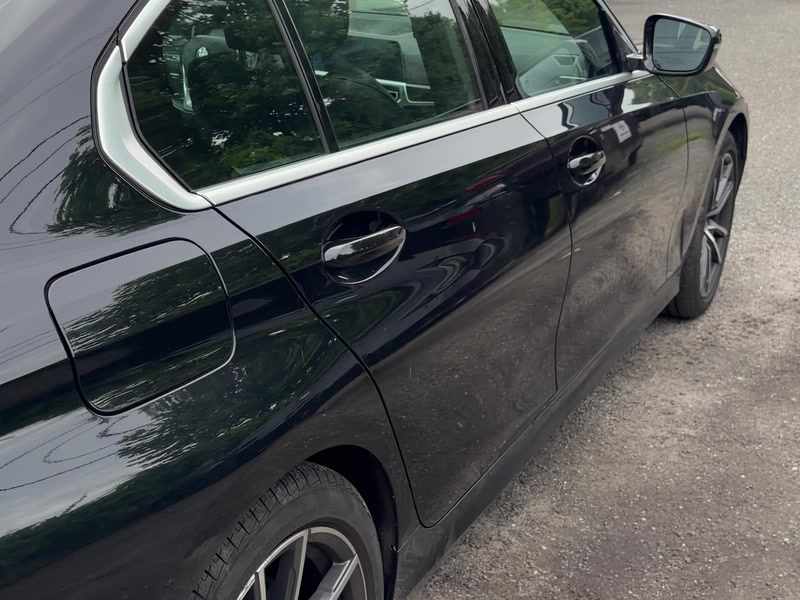
What we use, and why
- Ceramic film
- Highest heat rejection for a given shade, no signal interference, colour-stable for life.
- Carbon film
- Strong heat rejection and a neutral black that does not fade purple. The value pick.
- UV blocking
- Quality film blocks effectively all UV at any shade — this is what saves the dash.
Durability and aftercare
- Film life
- Quality carbon and ceramic films hold their colour and stay put for years. Cheap dyed film purples and bubbles. We tell you which line we are fitting before we start.
- The first week
- Do not roll the windows down for the period we specify at pickup, usually three to five days. Haze and water pockets are the adhesive curing.
- Cleaning
- Ammonia-free glass cleaner and soft microfiber only. Ammonia breaks down film adhesive — it is what turns old tint purple and bubbled.
- New York inspection
- Front sides and the windshield are metered at annual inspection. Film below the legal limit fails and has to come off. We install to the legal standard so that does not happen.
Window Tint questions
What is the legal tint limit in New York?
Front side windows and the windshield must let more than 70% of light through, so no film darker than 70% VLT on the front sides. Rear glass is generally unrestricted on passenger cars. Verify the current statute before relying on this.
Will tint make my car fail inspection?
New York meters front window and windshield light transmission at annual inspection. Too dark fails and has to come off. We install front windows at the legal limit.
How much heat will it actually stop?
It depends far more on the film than the darkness. A quality ceramic rejects a large share of infrared even at a near-clear 70% VLT; cheap dyed film at 20% does much less while looking far darker.
Will tint block my phone, GPS or key fob?
Not with carbon or ceramic film. Older metallized films did interfere — that is a solved problem in what we install.
Are there medical exemptions?
New York provides an exemption process for documented conditions, granted by the state rather than by an installer. Bring approved paperwork and we install to what it permits. PLACEHOLDER: confirm the current application process before publishing specifics.
Often booked together
Paint Protection Film
Self-healing urethane film that physically stops rock chips.
Quoted per vehicle →Ceramic Coating
Gtechniq Crystal Serum Light and EXO V5. Years of protection, not months.
From $750 →Interior Detailing
Steam, shampoo and heated extraction — down to the carpet backing.
From $200 →Window Tint near you
Shop service in Medford, with pickup and dropoff across Suffolk County.
- Medford about 5 min · 1 mi
- Patchogue about 10 min · 5 mi
- East Patchogue about 10 min · 5 mi
- Holbrook about 10 min · 7 mi
- Holtsville about 5 min · 4 mi
- Farmingville about 5 min · 4 mi
- Selden about 10 min · 5 mi
- Centereach about 15 min · 8 mi
- Coram about 10 min · 5 mi
- Middle Island about 10 min · 6 mi
- Bellport about 10 min · 7 mi
- Yaphank about 10 min · 5 mi